Sunday, 5 June 2016

NYX Demo

Hello!

I wanted to make a video on my NYX lipstick so everyone can see the products i recommend :)


Bye!

Friday, 3 June 2016

Benefit?- Is It Cruelty Free?

Hello!

Sorry we have been so inactive! :(

It is hard to work out whether Benefit is cruelty free.
It is on Peta's cruelty free list but on google it says they are cruelty free.

"Benefit is against cruelty to animals. It is our goal to be as transparent and honest with our customers as possible. We believe the "cruelty free" certifications provide unclear explanations to consumers, as it implies that none of the ingredients incorporated into products have ever been tested on animals."

So I emailed them and they also said they were cruelty free.

I said, "If you are 100% cruelty free why are you on Peta's 'tests on animals' list?"

Benefit replied, "Thank you for taking the time to write us.
Since 1989, we do not perform any test on animals for the products we put on the market. This was implemented long before the 2013 official ban set by the European Union.We are deeply committed to the elimination of animal testing and we are playing a leading role in developing alternative methods through our support of the “Fund for Alternatives to Animal Testing” in the United States and our active participation to validation studies of new alternative tests in the framework of the European cosmetics association (Cosmetics Europe). Additionally, we are one of only a few companies to have invested in creating our own internal department to test raw materials and ingredients to further ensure the quality of our products and the satisfaction of our customers, which is our foremost priority.
We are hopeful that alternative testing methods will be adopted worldwide and we will see an end to animal testing."

Please help us work this out!

Bye!

Saturday, 21 May 2016

Animal Rights

Hello 

These  are the animal rights from +PETA (People for the Ethical Treatment of Animals) 
People who support animal rights recognise that all animals have an inherent worth – a value completely separate from their usefulness to humans. We believe that every being with a will to live has the right to live free from exploitation and suffering.
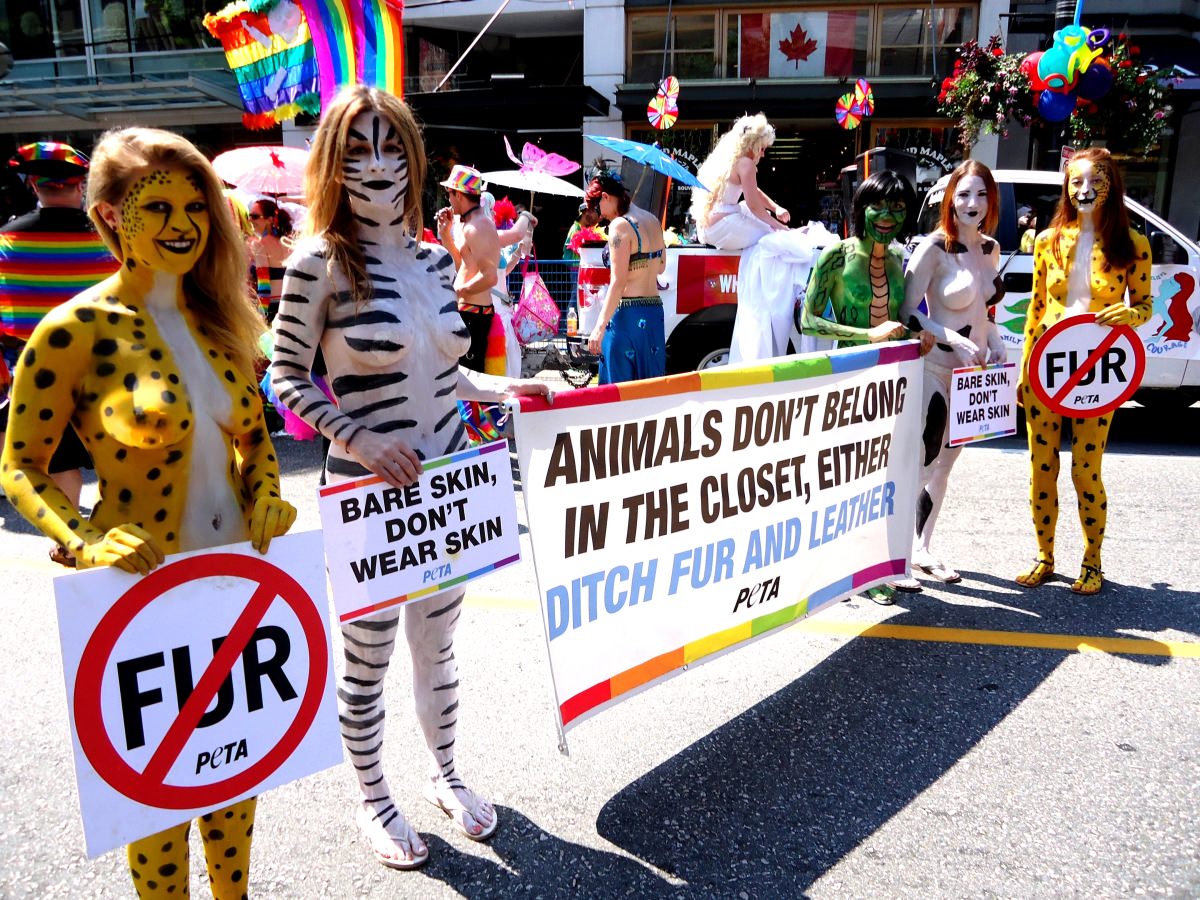
Fur_demo_vancouver_pride_parade_2013Here are a few ways of understanding this vibrant, exciting movement.

It’s a Philosophy

Animal rights is based on ethical and moral philosophy. It has been discussed by some of the world’s most influential thinkers, from historical figures such as Pythagoras and Leonardo da Vinci – who embraced vegetarianism – to Jeremy Bentham, the founder of the utilitarian school of philosophy, who famously identified animals’ capacity for suffering as the characteristic that gives them a right to equal consideration.

“The question is not ‘Can they reason?’ nor ‘Can they talk?’ but ‘Can they suffer?'”
– Jeremy Bentham

All animals have the ability to suffer in the same way and to the same degree that humans do. They feel pain, pleasure, fear, frustration, loneliness and familial love. Whenever we consider doing something that would interfere with their needs, we are morally obligated to take them into account.
In his book Animal Liberation, the philosopher Peter Singer states that the basic principle of equality does not require equal treatment – it requires equal consideration. This is an important distinction when talking about animal rights. People often ask if animal rights means that animals should have the right to vote or drive a car. Of course, that would be silly because those aren’t rights that would benefit animals. But animals have the right not to suffer at the hands of humans and to live their lives free from suffering and exploitation because they have an interest in doing so. That is the difference between equal consideration and equal treatment.

It’s Intuitive

You don’t have to be a philosopher to know that hurting animals is wrong. At its core, animal rights is simple. It’s about being kind to others – whether they’re members of our own species or not.
Almost everyone cares about animals in some context, whether it’s a beloved family companion, an irresistibly cute kitten or a majestic wild animal seen in a documentary. After all, we each have some built-in capacity for empathy and compassion, as can be seen from the lengths that children often go to in order to help animals.
Logically and morally, there’s no reason to differentiate in the way we treat the animals we share our homes with and those who are farmed for food. They’re all individuals, with the same capacity to feel pain and fear. Animal rights helps us to look past the arbitrary distinctions between different species, to rediscover our innate compassion and to respect all animals equally.

“When it comes to pain, love, joy, loneliness and fear, a rat is a pig is a dog is a boy. Each one values his or her life and fights the knife.”

– PETA founder Ingrid E. Newkirk

It’s a Way of Life

There’s nothing abstract about animal rights, and there are no barriers to getting involved. Anyone who cares about animals can start putting these principles into practice every single day with the food they eat, the clothes they wear and the products they buy. These choices are a form of nonviolent protest that makes a real difference both by reducing the profits of corporations that harm or kill animals and by creating a growing market for cruelty-free food, fashion, services and entertainment.
To learn more about making kind choices, visit the Living section of our website and order a free vegan starter kit.

“Never doubt that a small group of thoughtful, committed citizens can change the world.”
– Margaret Mead

It’s a Social Movement

Like other major social movements, animal rights brings people together from across political, religious and cultural boundaries to fight against injustice.
And like those movements, it’s also about fairness. Only prejudice allows us to deny others the rights that we expect to have for ourselves. Whether it’s based on race, gender, sexual orientation or species, prejudice is morally unacceptable. Alongside the struggles against racism, sexism and homophobia, there’s the struggle against speciesism – discrimination against other beings on the basis of their species.

“Injustice anywhere is a threat to justice everywhere.”
– Dr Martin Luther King Jr

It’s the Way Forward

Society is evolving and becoming fairer all the time. Despite all the people who say change will never happen, most countries in the world have outlawed human slavery and child labour  Recognising the rights of animals is the next stage in our progress towards a fairer world.
As biologists and animal behaviourists learn more about animals’ intelligence and the complexity of their lives, there’s even less excuse for treating them as commodities rather than the sensitive individuals they are.
Most of us grew up eating meat, wearing leather and visiting zoos. Yet, just as we’ve made the mental shift towards a way of life that respects animals, so society as a whole must outgrow the unethical mindset that animals are here for us to use and kill as we please.

“The greatness of a nation and its moral progress can be judged by the way its animals are treated.”
– Mahatma Gandhi


Bye! 
Animal Testing

Hello!

I just was looking at animal testing quotes, they are very inspiring.

The idea that some lives matter less is the root of all that is wrong with the world. Imagine if you were on the other side staring out wondering why are you hurting me? 100 million animals are killed in labs every year. Animals to not deserve to be in labs, what have they done? Beauty doesn't hurt so why do people hurt them? Why do people buy products that have been tested on animals after all? To selfishly put on their face to look good? If so many people were against animal testing people would think it was disgusting to put that kind of product on your face. It just shows that brands cannot trust what they are putting in their products.

Bye!

Wednesday, 18 May 2016

1.5K!

Hello!

Thank you so much for making this happen, we have reached 1.5K! Every single on of you that reads this blog raises more awareness and so far, its helped lots! This blog means a lot to us as it helps us spread the word about Animal Testing and Cruelty. Now we have contacted larger companies meaning we can try to put an end Animal Testing.

Please keep reading our blog to find out more about Animal testing and help us stop it!
Raise Awareness and thank you!

Bye!

Reasons To Be Against Animal Testing

Hello!

Some people think animal testing is okay, when really they know it isn't.
Some people are selfish and think that it doesn't matter if animals died for a product because in the end, it will make them look amazing.
Some people, like me, hate animal testing and I am glad for what we have done to contact companies and change thousands of peoples minds!

I got this information from Cruelty Free International and for those people who are for animal testing please read this:

Animal experiments are cruel, unreliable, and even dangerous
The harmful use of animals in experiments is not only cruel but also often ineffective. Animals do not get many of the human diseases that people do, such as major types of heart disease, many types of cancer, HIV, Parkinson’s disease, or schizophrenia.  Instead, signs of these diseases are artificially induced  in animals in laboratories in an attempt to mimic the  human disease. Yet, such experiments belittle the complexity of human conditions which are affected by wide-ranging variables such as genetics, socio-economic factors, deeply-rooted psychological issues and different personal experiences.
It is not surprising to find that treatments showing ‘promise’ in animals rarely work in humans. Not only are time, money and animals’ lives being wasted (with a huge amount of suffering), but effective treatments are being mistakenly discarded and harmful treatments are getting through. The support for animal testing is based largely on anecdote and is not backed up, we believe, by the scientific evidence that is out there.
Despite many decades of studying conditions such as cancer, Alzheimer’s disease, Parkinson’s disease, diabetes, stroke and AIDS in animals, we do not yet have reliable and fully effective cures.
 The history of cancer research has been the history of curing cancer in the mouse. We have cured mice of cancer for decades and it simply didn’t work in human beings. Dr. Richard Klausner, former director of the US National Cancer Institute

Unreliable animal testing

  • 95% of drugs fail in human trials despite promising results in animal tests – whether on safety grounds or because they do not work
  • Using dogs, rats, mice and rabbits to test whether or not a drug will be safe for humans provides little statistically useful insight, our recent analysis found
  • Out of 93 dangerous drug side effects, only 19% could have been predicted by animal tests, a recent study found
  • Using mice and rats to test the safety of drugs in humans is only accurate 43% of the time, a recent study found

Wasteful animal testing

  • Despite the use of over 115 million animals in experiments globally each year, on average only 25 new medicines are approved annually by the leading drug regulator, the U.S. Food and Drug Administration. Many of these are for rare diseases.
  • The US drug industry invests $50 billion per year in research, but the approval rate of new drugs is the same as it was 50 years ago.
  • Only 6% of 4,300 international companies involved in drug development have registered a new drug with the U.S. Food and Drug Administration since 1950.
  • Even those drugs that are approved are not universally effective due to individual reactions - the top ten highest-grossing drugs in the USA only help between 1 in 4 and 1 in 25 people who take them
  • Of over 1,000 potential stroke treatments that had been ‘successful’ in animal tests, only approximately 10% progressed to human trials.  None worked sufficiently well in humans.
  • A review of 101 high impact basic science discoveries based on animal experiments found that only 5% resulted in approved treatments within 20 years.

Dangerous animal testing

  • Vioxx, a drug used to treat arthritis, was found to be safe when tested in monkeys (and five other animal species) but has been estimated to have caused around 320,000 heart attacks and strokes and 140,000 deaths worldwide.  
  • Human volunteers testing a new monoclonal antibody treatment (TGN1412) at Northwick Park Hospital, UK in 2006 suffered a severe allergic reaction and nearly died. Testing on monkeys at 500 times the dose given to the volunteers totally failed to predict the dangerous side effects.
  • A clinical trial of Hepatitis B drug fialuridine had to be stopped because it caused severe liver damage in seven patients, five of whom died.  It had been tested on animals first.
  • Only one third of substances known to cause cancer in humans have been shown to cause cancer in animals.

Animals are different

  • Animals do not get many of the diseases we do, such as Parkinson’s disease, major types of heart disease, many types of cancer, Alzheimer’s disease, HIV or schizophrenia.
  • An analysis of over 100 mouse cell types found that only 50% of the DNA responsible for regulating genes in mice could be matched with human DNA.
  • The most commonly used species of monkey to test drug safety (Cynomolgous macaque monkeys), are resistant to doses of paracetamol (acetaminophen) that would be deadly in humans.
  • Chocolate, grapes, raisins, avocados and macadamia nuts are harmless in people but toxic to dogs.
  • Aspirin is toxic to many animals, including cats, mice and rats and would not be on our pharmacy shelves if it had been tested according to current animal testing standards. 
Animal experiments are cruel, unreliable, and even dangerous.

Have I changed any minds?

Bye!

Sunday, 15 May 2016

NYX

Hello!

On the 10th of May, NYX arrived in my local boots store. I am now addicted to it!

Their products are amazing and such good quality.

Today I purchased a soft matte lip cream and it is one of the best things I have ever bought!

Cannes and Stockholm